You're on the couch after dinner, or lying in bed about to fall asleep, and suddenly you notice it: your heart is pounding, running fast, or seems to skip and then thump hard inside your chest. It lasts a few seconds, sometimes a few minutes, then settles. The worry takes longer to settle. That feeling is called palpitations, and while it can be frightening, it very often has a simple explanation. Sometimes, though, it is a clue worth following. This guide helps you tell the two apart.
What palpitations actually feel like
Most of the time we don't notice our heartbeat at all. Palpitations are the moments when you suddenly become aware of it, and people describe them in very different ways:
- Strong thumping in the chest, the neck, or even the ears when you lie down.
- A fast fluttering, like a small bird trapped behind the ribs.
- A pause followed by one harder beat, as if the heart "tripped."
- A racing spell that switches on and off abruptly, with no effort to explain it.
A pulse that climbs while you take the stairs or jog is normal. What stands out is a heart that speeds up for no reason while you're resting, or a rhythm that feels uneven.
The most common causes (and the easiest to fix)
In healthy people, most palpitations come from something stimulating the heart from the outside. Before assuming the worst, go through this list honestly:
Coffee, cola and energy drinks. Caffeine pushes the rate up, especially when several cups stack up with a large soda at lunch and an energy drink to get through a night shift. Energy drinks often list other stimulants on the label as well.
Stress and anxiety. When the body senses a threat, it releases adrenaline and the heart gets ready to run. Worries about money, work or immigration paperwork can keep that switch on for days, and the pounding shows up right when you finally lie down and the quiet lets you hear it.
Too little sleep. A week of five-hour nights wears on the heart more than people expect. Many notice skipped or racing beats exactly after a stretch of late nights.
Fever and dehydration. A fever raises the pulse as part of the body's defense. If you also sweated hard working outdoors, had vomiting or diarrhea, or simply drank too little water, there is less fluid in circulation and the heart compensates by beating faster.
Alcohol and tobacco. A night of drinking can leave the rhythm unsettled the next day. Nicotine is a stimulant too.
Some medicines. Certain cold remedies with decongestants, some asthma inhalers, diet pills and "energy" supplements can speed up the pulse. Don't stop any of them on your own: write down what you take and talk with the medical team before changing anything.
Causes found with a lab test
Some conditions inside the body also speed up the heart, and you can't see them in a mirror:
The thyroid. When the gland works overtime (hyperthyroidism), everything runs fast: palpitations, jitters, shaky hands, feeling hot and sweaty, weight loss while eating the same as always. It is checked with a thyroid function blood test measuring TSH, T3 and T4.
Anemia. With too few red blood cells, your blood carries less oxygen, so the heart beats faster to deliver what there is. It usually comes with tiredness, pale skin and getting winded on stairs. Very heavy periods are a frequent cause in women. A complete blood count among your blood tests shows it.
Blood sugar. A low-sugar episode, especially in people treated for diabetes, brings a cold sweat, trembling and a racing heart. If you live with diabetes, check your glucose at the moment you feel it.
Hormonal shifts. Pregnancy and menopause can also bring spells of a fast heartbeat.
And the heart's own rhythm
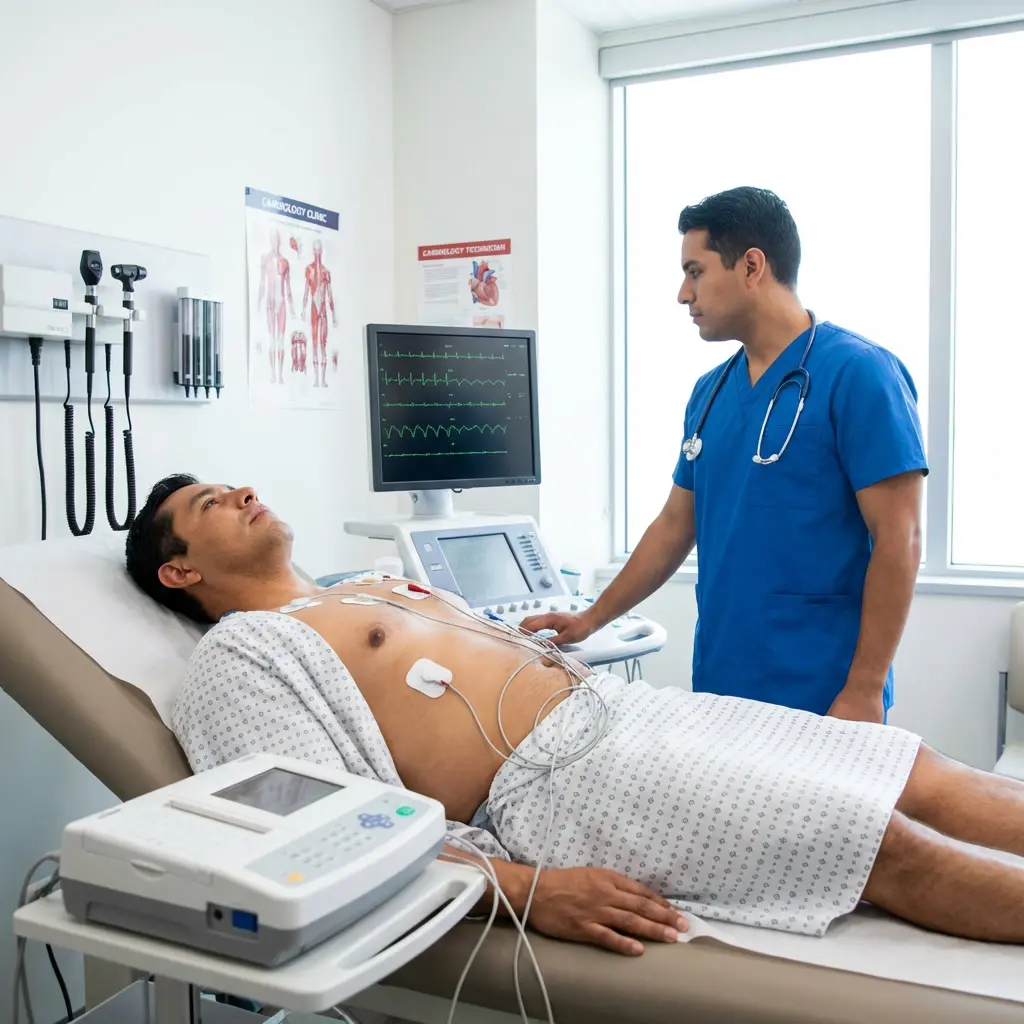
Sometimes the source is the heart's electrical system. "Extra beats" (premature beats) are very common and usually harmless, but some arrhythmias do need treatment. The tool that separates them is the electrocardiogram (EKG): electrodes on your chest, arms and legs record the heart's electrical activity in a few minutes, painlessly. At our Gessner Rd clinic it is done during the visit, and palpitations are one of the reasons it gets ordered.
One thing to keep in mind: an EKG captures the rhythm of those few minutes. If your heart behaves while you're on the exam table, the tracing can come out clean even though your palpitations are real. That is why what you observe at home matters so much.
What to write down when it happens
A simple log beats any description from memory. On your phone or in a notebook, record:
- Date and time, and what you were doing (resting, working, after a meal, lying down).
- How long it lasted: seconds, minutes, longer.
- How it started and stopped: suddenly or gradually.
- Your pulse, if you can take it: place two fingers on the thumb side of your wrist, count the beats for 30 seconds and double the number. Notice too whether it feels steady or irregular.
- What you had beforehand: coffee, an energy drink, alcohol, any medicine.
- Anything else you felt: dizziness, sweating, shortness of breath, pain.
If you own a smartwatch or a home blood pressure cuff that shows your pulse, save the readings and bring them to the visit.
When it's a 911 call, not a clinic visit
Call 911 if palpitations come with any of these signs:
- Blacking out, or the room going gray as if you might collapse.
- A squeezing weight in the chest along with the racing beat, or one that travels toward the shoulder, jaw or between the shoulder blades.
- Shortness of breath that comes on suddenly.
- A cold sweat, confusion, or a very fast heartbeat that won't slow down at rest.
In those situations don't drive yourself or ask someone to take you to a clinic: paramedics start treating you the moment they arrive.
When it's worth getting checked
With no warning signs, it's still worth a visit if:
- Palpitations come back several times a week or last more than a few minutes.
- They show up during exertion or force you to stop.
- You already have high blood pressure, diabetes or a known thyroid problem.
- Someone in your family had heart trouble at a young age or died suddenly.
- You also notice fatigue, weight loss, trembling or very heavy periods.
At the visit, the clinic's medical team goes over everything in your log, takes your blood pressure and pulse, listens to your heart and, depending on what they find, may order an EKG, thyroid tests or other blood work during the same visit. If managing high blood pressure or diabetes is part of the picture, that continues within our chronic conditions program. When the rhythm needs watching over a longer stretch, general medical practice turns to a monitor that records the heart for several days or to a specialized evaluation.
Getting your heart checked in Spring Branch
If your heart tends to race at night and your days leave no room for a visit, Clínica Hispana Nueva Salud Gessner on Gessner Rd (77080) sees patients until 9 PM, Saturdays and Sundays included. Bring your palpitations log, the boxes of any medicines and supplements you take and, if you have them, the readings from your watch or blood pressure cuff. If treatment turns out to be needed, the prescription is sent electronically to the pharmacy you choose, and the team explains what to keep an eye on at home until your next check.
This article is general guidance and does not replace an in-person evaluation by the clinic's medical team.